This is a library of perfboard and single-sided PCB effect layouts for guitar and bass. I'm not an electrical engineer by any stretch of the imagination, just a DIY'er who likes drawing layouts. It is meant for the hobbyist (so commercial use of any of these layout is not allowed without permission) and as a way to give back to the online DIY community.

Wednesday, March 30, 2016

Wampler Faux Spring Reverb

The Faux Spring Reverb, like many pedal reverbs is based around a Belton reverb module. Originally it used the BTDR-1 (which is massive), but in this layout I've adapted it for the newer and smaller BTDR-2H. I've also simplified the power section a little, and used a TL071 for the second IC. In the original a TL072 was used, but only used half of it. Here's what Brian has to say about his design:

The great thing about the Faux Spring Reverb is that it retains the Analog base tone, doesn’t send your signal through digital/analog converters and back again (wrecking your tone completely) allowing you to be as springy as you like without your sound becoming lifeless, dull and… well, bad. With the tone control, you can control your sound completely and have your reverb be as bright as day, or dark as night… As lively and bright as a small hall, or as deep as the biggest cathedrals.


Edit: I realized this afternoon that the Depth pot would hit the Belton brick, so I've changed it to a 9mm pot and it will clear the brick. The whole thing will be really snug, but it should be doable.

Monday, March 28, 2016

Death by Audio Evil Filter

Here's an unreleased version of the Evil Filter. It's similar but not quite the same as the original. The schematic was pulled from a video interviewing DBA's Oliver Ackermann and was redrawn here. Some of the parts are a little pricey but the resulting sound is apparently amazing.

Friday, March 25, 2016

Zvex Fat Fuzz Factory

For Fuzz Friday, here's a layout for the Fat Fuzz Factory in a 1590B in a more traditional orientation. All pots are board mounted as well as the Fat Switch. For C1 and C2 you'll probably want to experiment with values. Using an on/off/on switch gives you an extra option over the original. 3.3uF is a good place to start with one of them. Just a note, whatever value you chose will be in parallel with the existing 100nF cap. Thanks to p0mp0 for sending in his layout.


Wednesday, March 23, 2016

Mad Professor Stone Grey Distortion

Here's the Stone Grey Distortion from Mad Professor. It's reminiscent of the Distortion +/OD250 circuit, but with a hex inverter stuck after the opamp. It also uses 2 JFETs in the feedback loop of the opamp for clipping. Original op amp is the TL051, but other single opamps can be used (Tl061, 71, etc). Should be an easy fit in a 1590B. Mind the jumper under the CB4069UBE.


Monday, March 21, 2016

JHS Honeycomb Deluxe

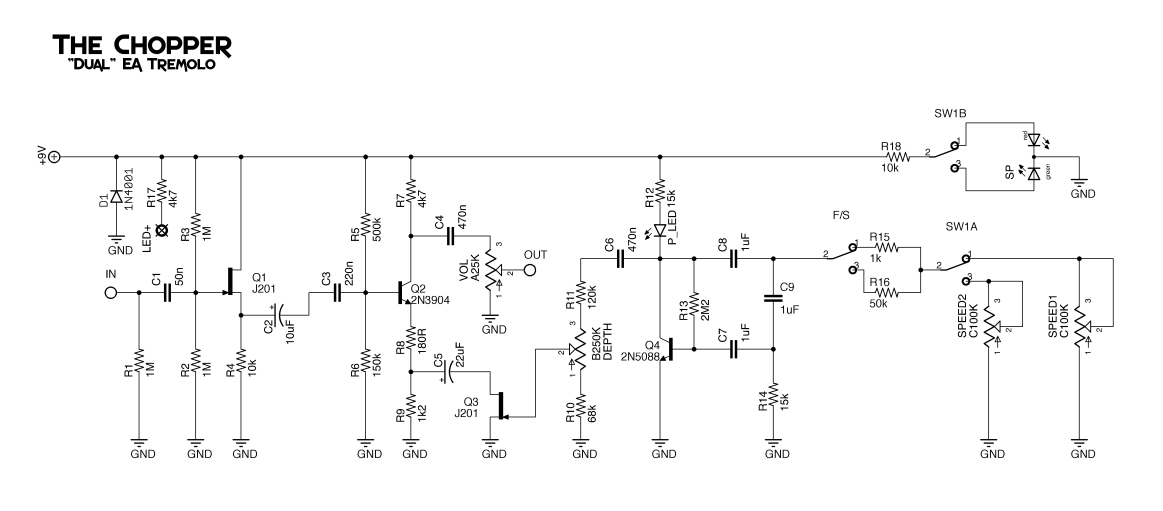
Here's JHS' Honeycomb Deluxe tremolo. Or something close to it anyway. It's a modified EA Tremolo with an extra switch to control speed and a extra footswitch to switch between speed controls. Ian McDermott came up with a work-a-like for it, so this layout follows his schematic. This layout features board mounted pots and because of the 2nd footswitch I've laid it out for a 1590BB enclosure. Also this is laid out for film box caps like these, though others will work just fine.


Friday, March 18, 2016

Cornish Buffer

Got a request for the Pete Cornish Buffer in dual form like the one I did with the Klon Buffer. So here's both a single and a dual Cornish Buffer. The original uses a 1N5401 for polarity protection, but a 4001 or similar will work too. And you can probably get away with a small value on the power filter cap (220µ).

Wednesday, March 16, 2016

Klon Centaur - True Bypass

Here's the Klon again. I wanted one with board mounted pots and for a smaller enclosure. You might be able to fit this in a 1590B with low profile jacks, but it will easily fit in a 125B. It's designed for 9mm PCB mount pots, though it might be difficult to find the dual-gang Gain pot. Look for Alpha part number RD902F-40-00. I've removed a few components that were apart of the stock bypass switching for the sake of space, so you'll want to use your true bypass method of choice with this one.