

Thursday, July 9, 2015
Wampler Distortion Plus Mods
A while back Brian Wampler shared a bunch of mods to the classic MXR Distortion Plus circuit in Premiere Guitar magazine. It adds a tone control, a switchable soft clipping stage, a compression switch, and a bass boost switch.


Wednesday, July 8, 2015
Electro Harmonix Germanium OD
The EHX Germanium OD offers 60s overdrive tones using a combination of germanium and silicon transistors (all PNP). All 3 pots control the voltage is some way. The Bias pot controls the amount of voltage that reaches the Gain control, which in turn controls the remaining voltage that gets to the germanium transistor. The Volts control acts like a sag control on the overall voltage the circuit is running at, so you can emulate a dying battery. I've laid this out for on board pots mounted from the solder-side of the board using right angle PCB mount pots.


Tuesday, July 7, 2015
Fender Blender
The Fender Blender would probably just be a blip in the history of fuzz if it weren't for the likes of Billy Corgan (Smashing Pumpkins) and Kevin Shields (My Bloody Valentine), as it was generally regarded as too harsh sounding. This aggressive fuzz is good for metal leads and also can create an octavia sound on the neck pickup with the Sustain control rolled down. The Boost footswitch is actually a tone boost, and uses a SPDT switch (or DPDT if you want LED indication). I've laid the circuit out for on board, right angle pots, mounted from the solder side (or you can use long leg ones mounted from the component side). I've increased the power filtering cap and added polarity protection as well as input and output pull down resistors, and on board LED resistors. With the 2 footswitches, I thought it would be best to design the layout for a 1590BB oriented like this, so keep that in mind.


Monday, July 6, 2015
Seymour Duncan Pickup Booster
The Seymour Duncan Pickup Booster offers 25 dB of clean boost with flat EQ (and it's also a line driver). It uses a combination of two NPN and one PNP transistor. Originals use BC107s and BC177s, but other transistors should work fine as well. Check out the demo video below for more info.

Friday, July 3, 2015
Univox SquareWave
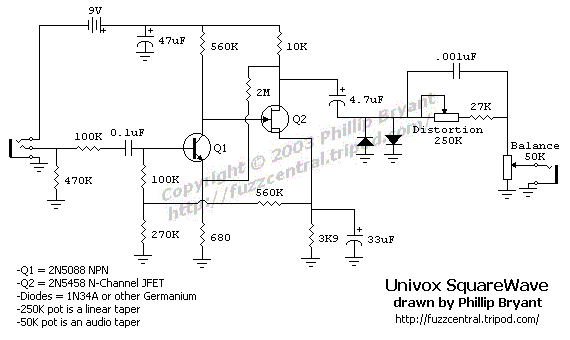
This is a pretty unique fuzz from the mid-70s by Univox. It was designed by Shin-Ei and like a few other Shin-Ei designs it can suffer from volume loss. To get it back up to unity or above, DIYSB forum member LucifersTrip made some mods to the circuit that keep the original sound, but improve the circuit a little bit. (Here's the original schematic, and LT's schematic for reference)
Volume problem:
To increase volume, I slowly increased the vol pot. Even at 1M, it was still below unity. So, I added diodes in parallel. Finally it was above unity, but now the distortion (really a tone control...closer to 0K the more bassy) didn't give me a good sweep. So, I simply increased the 27K cutoff to 100K and subbed a 1M distortion pot instead of the 250K. Beautiful! That gave me a nice sweep from just barely too bassy to a nice thin fuzz.
Mild Gating Problem:
Anytime I see an odd small value from an emitter, base or collector to a rail, I always suspect it to be very sensitive, and it was...I slowly increased from 0K and hit a perfect spot around 2.6-2.8K. The mild gating and pick percussion were gone, resulting in a killer smooth fuzz with super long sustain. It was nearly perfect, but a bit too harsh on the highs. A simple tweaking of the 680 gave me a sweet spot right around 1.8-2.2K. If you raise it much higher, you'll wind up with less power...and around 4-5K will start to gate again. Further, I increased the 2M to 3M, which gave a bit more richness to the higher strings. I tried up to 7M...still good (thicker on the high strings) but I didn't want to take a chance it would change the tone too much.
Here's a demo of the original:

If you want use this layout to build the SquareWave to original specs, follow the below value changes:

Volume problem:
To increase volume, I slowly increased the vol pot. Even at 1M, it was still below unity. So, I added diodes in parallel. Finally it was above unity, but now the distortion (really a tone control...closer to 0K the more bassy) didn't give me a good sweep. So, I simply increased the 27K cutoff to 100K and subbed a 1M distortion pot instead of the 250K. Beautiful! That gave me a nice sweep from just barely too bassy to a nice thin fuzz.
Mild Gating Problem:
Anytime I see an odd small value from an emitter, base or collector to a rail, I always suspect it to be very sensitive, and it was...I slowly increased from 0K and hit a perfect spot around 2.6-2.8K. The mild gating and pick percussion were gone, resulting in a killer smooth fuzz with super long sustain. It was nearly perfect, but a bit too harsh on the highs. A simple tweaking of the 680 gave me a sweet spot right around 1.8-2.2K. If you raise it much higher, you'll wind up with less power...and around 4-5K will start to gate again. Further, I increased the 2M to 3M, which gave a bit more richness to the higher strings. I tried up to 7M...still good (thicker on the high strings) but I didn't want to take a chance it would change the tone too much.
Here's a demo of the original:

If you want use this layout to build the SquareWave to original specs, follow the below value changes:
- Change the 1.9k resistor to 680Ω
- Change the 2.8k resistor to 3.9k
- Change the 3M resistor to 2M
- Use a 2N5458 for Q2
- Jumper D3 and D4
- Change the 100k resistor by the diodes to 27k
- Use B250k pot for Distortion control
- Use A50k pot for Balance control
Thursday, July 2, 2015
MicTester's Guitar Compressor
Here's a compressor design from MicTester. Here's what he had to say about it over on FSB:
Do you remember the old-fashioned way of doing bass compression? It used an LDR across the volume control illuminated by an incandescent lamp across the speaker terminals! It was a simple method back in the 60s....
This compressor is almost that simple! It uses a handful of cheap components (I built one for £9 including hardware!), but works really well. Guitarists who've tried it often ask "Is it on?", but miss it when it's off! It's quiet, and has good "squeeze" without the gain-change artifacts you frequently get with transconductance amplifiers or FETs.
The LDR should be ~1M in the dark, but almost anything will do.
Some of the component values are quite carefully chosen. The input capacitor (15nF - made up of a 10 and a 4.7 if the 15 is unavailable) is chosen to give some frequency shaping, and the interstage capacitor prevents handling noise affecting the compression. Green LEDs are chosen because they most closely match the response of the LDR, but yellow works almost as well. Obviously, the LDR / LED combination should be facing each other, and must be in a light-tight enclosure.
I've set up the board with pads for both 10nF and 4.7nF in parallel if you don't have a 15nF cap.

Do you remember the old-fashioned way of doing bass compression? It used an LDR across the volume control illuminated by an incandescent lamp across the speaker terminals! It was a simple method back in the 60s....
This compressor is almost that simple! It uses a handful of cheap components (I built one for £9 including hardware!), but works really well. Guitarists who've tried it often ask "Is it on?", but miss it when it's off! It's quiet, and has good "squeeze" without the gain-change artifacts you frequently get with transconductance amplifiers or FETs.
The LDR should be ~1M in the dark, but almost anything will do.
Some of the component values are quite carefully chosen. The input capacitor (15nF - made up of a 10 and a 4.7 if the 15 is unavailable) is chosen to give some frequency shaping, and the interstage capacitor prevents handling noise affecting the compression. Green LEDs are chosen because they most closely match the response of the LDR, but yellow works almost as well. Obviously, the LDR / LED combination should be facing each other, and must be in a light-tight enclosure.
I've set up the board with pads for both 10nF and 4.7nF in parallel if you don't have a 15nF cap.

Wednesday, July 1, 2015
Univox Super Fuzz
This circuit is most known for being manufactures and sold by Univox, but was designed by Shin-Ei as the FY-6 and licensed to several manufacturers including Ibanez, Teisco, Kent, Companion, Apollo, and several others. The Super Fuzz has been used by many guitarist since it was first made in 1968, including Pete Townsend, J Mascis, Poison Ivy, and Josh Homme, just to name a few.
I did a layout of the Super Fuzz almost 8 months ago, and was always disappointed it wasn't really 1590B friendly. Well, I finally got around to redoing it and this version should fit just fine in 1590B. I based it off the original Super Fuzz circuit board, but with non-standing components and added polarity protection, increased the power filter cap, and added a pull down resistor.

I did a layout of the Super Fuzz almost 8 months ago, and was always disappointed it wasn't really 1590B friendly. Well, I finally got around to redoing it and this version should fit just fine in 1590B. I based it off the original Super Fuzz circuit board, but with non-standing components and added polarity protection, increased the power filter cap, and added a pull down resistor.

Subscribe to:
Posts (Atom)