

Wednesday, May 27, 2015
Rotary Capacitor Switch
The input caps on some old circuits like the Fuzz Face, Tone Bender, or Rangemaster are ripe for variation. Here's a board that will allow you to switch between 6 different capacitors of your choice. You could also use this for a Gibson Varitone-like switch on a guitar. As with the Rotary Clipping Switch layout, use a 26mm enclosed 2 pole 6 position PC mount rotary switch (preferably from Alpha as their datasheet is what I used to layout the switch pads), mounted from the component side.


Rotary Clipping Switch
Ever want to have as many clipping options as possible on a distortion or overdrive pedal? Here's a way to add up to 6 different combinations of diodes, LEDs or Mosfets with a 6-way rotary switch. Here's the break down on the different diode layouts by switch position:

- Standard 2 diode orientation
- Asymmetrical diode orientation
- Diodes in series
- Mosfets
- Asymmetrical LED orientation
- Standard 2 LED orientation
You can always omit components from one of the switch positions to have a clipping bypass mode. You can also use jumpers or angle diodes if you don't want series or asymmetrical diodes. Use a 26mm enclosed 2 pole-6 position PC mount rotary switch (preferably from Alpha as their datasheet is what I used to layout the switch pads) and mount it on the component side.

Tuesday, May 26, 2015
Vox Treble Booster
The Vox Treble Booster was a simple silicon treble boost effect that plugged straight into an amp's input jack. It allowed the user a boost in high frequencies for lead work. I laid this one out to use as a built in effect on a guitar (hence the lack of a power filtering cap and polarity protection). Note that the 10uF cap is on its side to reduce the height of the populated board. It should easily fit in a 1590A. If you want a volume control use a 100k pot with the Out pad going to lug 3. Lug 2 becomes the Out and lug 1 goes to ground. I found that I really didn't need a volume pot though, as the effect level was right around unity.


Monday, May 25, 2015
JHS Morning Glory
The JHS Morning Glory is a modified Blues Breaker overdrive, but with an added JFET output buffer to increase the volume. The original Marshall circuits barely made it above unity with the volume maxed (see the video below), so the output buffer is a good improvement over the original. There's also a high cut switch to help tame single coils a bit. I wasn't quite able to get the on-board pots to be in the exact layout as the JHS units (the Tone control and High Cut switch are reversed), but it's close enough. You should be able to board mount the SPST high cut switch as well.


Friday, May 22, 2015
Greer Amps Ghetto Stomp
Here's another one of Nick Greer's offerings. Like Sean over at Lovepedal, he seems to be getting a lot of mileage out of the Electra circuit. I've laid this out for on-board pots with the board mounted vertically like this:

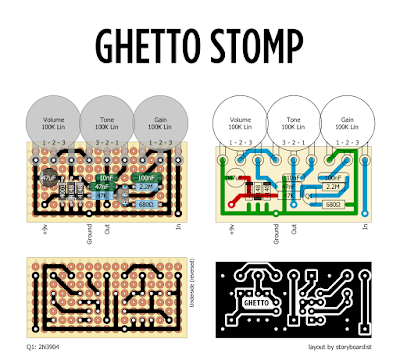

Photo by Bob Scott/negatron.org

I saw on the Greer Amps website that a special version of this was made with a BC107 transistor, so use that if you want to replicate the blue version of this pedal.
Thursday, May 21, 2015
Fredric Effects Unpleasant Companion
While we're on the subject of the Companion Fuzz, here's an adaption by British pedal company Fredric Effects. It replaces the fixed tone stack of the original FY-2 with a Big Muff tone stack, and adds a LPB-1 booster after the volume pot to increase the volume.


Wednesday, May 20, 2015
Shin Ei FY-2 Companion Fuzz
The epitome of buzzsaw fuzz tones, the Shin Ei Companion Fuzz has become a highly sought after fuzz box. The one drawback to the FY-2 is the tone stack between the Fuzz and Volume controls. Besides not being controllable, it drops the volume of the effect below unity. I've drawn up a stock layout, as well as a modded version with a booster at the output to up the volume to a more reasonable level (based on the schematic from General Guitar Gadgets). The stock layout will fit in a 1590A, and the boosted version could as well, it would just be a tighter fit.


A useful mod to the stock layout could be adding a tone bypass switch. Use a DPDT (on/on) and wire it like this:

When the tone stack is bypassed, the volume should increase significantly.
Subscribe to:
Posts (Atom)