This is a library of perfboard and single-sided PCB effect layouts for guitar and bass. I'm not an electrical engineer by any stretch of the imagination, just a DIY'er who likes drawing layouts. It is meant for the hobbyist (so commercial use of any of these layout is not allowed without permission) and as a way to give back to the online DIY community.
Showing posts with label Fulltone. Show all posts

Thursday, January 13, 2022

Fulltone 2B

 Happy 2022, everyone! Here's a buffer/booster from Fulltone. Engaged it's a booster with an interesting controllable germanium soft clipping setup, and when bypassed the diodes and gain control are shorted, creating a buffer. If you're just after the boost and want to skip the buffered bypass, just ignore the two Bypass pads and wire it normally. The original uses a 3PDT still for bypass, but you should be able to get away with a DPDT (just wire the bypass pads to lugs 1 and 2 of a DPDT, LED- to lug 4 and lug 5 to ground). Discussion and schematic over on FSB.


Friday, November 1, 2019

Fulltone Mas Malo

For Fuzz Friday, here's Fulltone's take on the Big Muff. The main differences over a regular BMP is the input and output stages. The input stage has it's own gain control and the output stage is a JFET-based gain circuit. Also the volume control has been moved immediately after the tone stack, with the output stage after the volume pot. Schematic for reference.


Friday, September 6, 2019

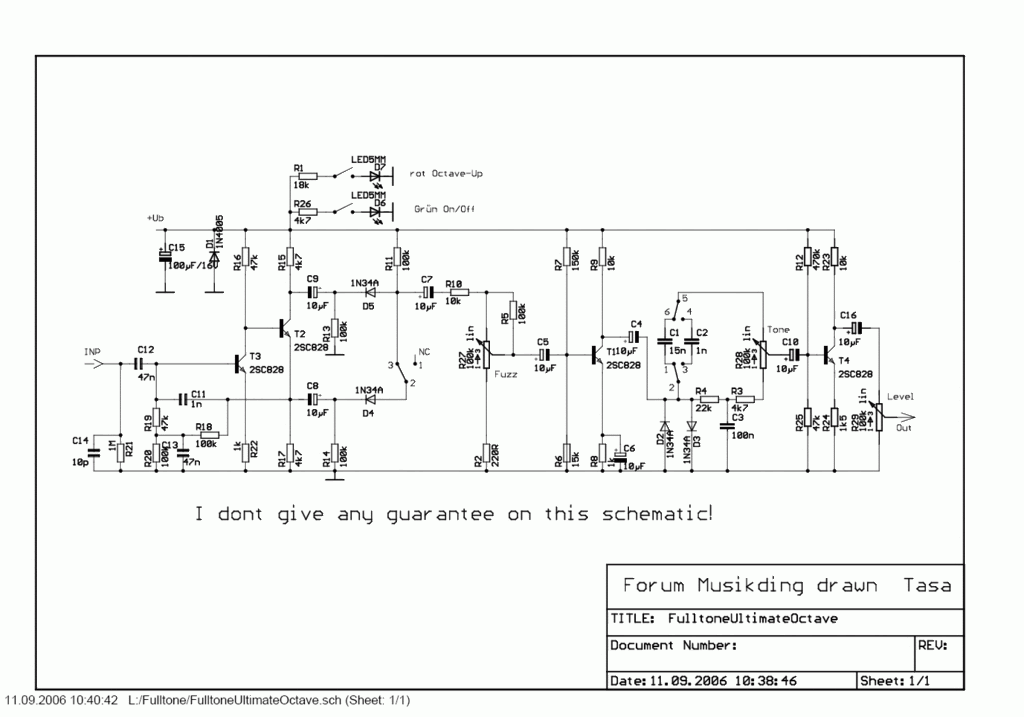
Fulltone Ultimate Octave

Happy Fuzz Friday everyone! Had a request for this one. It's basically a Foxx Tone Machine with some value changes and a couple additions, namely a switch to shift the range of the tone control and the octave switch is a footswitch. Here's the schematic for reference.


Thursday, August 1, 2019

Fulltone OCB

What's the OCB you ask? It's the bypass buffer circuit from the new version of Fulltone's OCD. It allows you to switch between regular true bypass and buffered bypass. There are 2 versions: The first (smaller) inverts the phase of your audio signal when engaged (in bypass mode phase isn't inverted). The second (larger) adds an extra inverting transistor stage so that the phase of the output signal is the same as the signal coming in. If you've built an earlier version of the OCD in the past, you can add the 2nd board to make it into the newer version.


Thursday, July 18, 2019

Fulltone OCD V2

The latest iteration of the OCD has quite a few differences from the earlier models. There's an added transistor stage at the output after the volume control, and a JFET buffer that can be toggled for buffered or true bypass. I've laid it out so it will still fit in a 1590B with board mounted pots.


The off-board wiring's not the most intuitive, so here's a diagram for wiring up the buffer switch and 3PDT bypass footswitch.

Tuesday, December 4, 2018

Mini BassDrive

This is an adaption of the Fulltone Bassdrive without the boost footswitch, allowing for a smaller enclosure. I got the idea from a comment by Simão on the Fulldrive 2 post, and I though it could prove useful for my fellow bassists. Like the Fulldrive/Bassdrive, it's modded Tube Screamer with clipping and voicing options with the 2 toggle switches. Based on this schematic with the boost footswitch and 2nd gain pot removed.

Wednesday, February 8, 2017

Fulltone RTO

The RTO (or Robin Trower Overdrive) from Fulltone is a modified Tube Screamer circuit. The input buffer is removed and the soft clipping stage has an interesting mix of diodes.


For a drilling template, use the Cmat Mods Signa.

Monday, June 27, 2016

Fulltone Fulldrive 2

I got a request for the Fulltone Bassdrive, and upon examining the schematic for it and the Fulldrive, there's only a few capacitor value changes between the two, which I'll detail below. All that to say, here's the Fulldrive 2 Mosfet. It's a Tube Screamer circuit with some interesting mods on it. Schematic is easily found on Google. Note that the Boost function of this circuit only works when the overdrive portion is already engaged. Pots can be board mounted and if the switch numbering is confusing consult the General Layout Notes tab for clarification.


For those of you who are interested in the bass version of this, use this layout to populate the Fulltone 2 board for the Bassdrive:

Wednesday, June 22, 2016

Fulltone OCD

I've been meaning to redo the OCD with proper board mounted pots, so here it is. It's a development on the Voodoo Labs Overdrive, with MOSFET clipping and a simple tone control. Fulltone has made a few versions of this with a few minor changes over the years. They're all mostly the same, but the biggest differences is in the pot values. Below is a partial bill of materials outlining the differences between the first 4 OCD versions, along with a couple value changes to mod the bass response.


Friday, September 18, 2015

Fulltone 70

For #fuzzfriday, here's the Fulltone 70 fuzz. Like the Fulltone 69, the 70 is a tweaked Fuzz Face circuit, following the silicon version. Like the original silicon Fuzz Face it uses BC108 transistors, though others can be used. Q2 should be higher gain than Q1. One of the nice things about the 70 is the added Mids control, which adjusts the some of the voltage reaching Q2 and the output capacitor. You can board mount the pots using right angle PCB mount types from the solder side.


Friday, August 21, 2015

Fulltone 69

Happy #fuzzfriday, everybody! The 69 is Fulltone's take on the classic, late 60s, germanium Fuzz Face circuit. They've added a few extra controls to help shape the fuzz. The Bias (or Input as it's called in the 69 Mk II) pot is a common mod to the Fuzz Face circuit (it's a trimmer in the AnalogMan Sunface) and controls the input impedance. It can clean up the sound a little, just like rolling down the volume pot on the guitar. The Contour pot controls some of the voltage going to Q2 and the output cap. For more info, here's the schematic. Pots can be board mount from the solder-side of the circuit board and it should all fit in a 1590B just fine. The perf side of the drawing shows positive ground and the PCB side shows negative ground. Typical Fuzz Face germanium transistors should be used (Q1: hFE ~70, Q2: hFE ~100), but as always, socket and experiment.


Monday, August 3, 2015

Super OCD

I stumbled across the schematic for this a while ago and have been meaning to lay it out for a while. It's Fred Brigg's souped up version of the Fulltone OCD. Here's what he had to say about it over on his blog:

The "Super OCD" has a few extra controls:

- Firstly the "Bass" control - it's nicked from Paul C's Timmy pedal and works very well to add in pregain bass for more low end response.

- Secondly the "Saturation" control, this allows you to increase the clipping headroom of the circuit and have an overall "cleaner" tone while dialling in just the required amount of diode clipping.

- Thirdly the "Boost" control, I've configured the second opamp to allow a range of clean boosts to be selected to really allow you to push the front end of your amp into overdrive.

- The final control I've added is a switch to go between 9 volt and 18 volt operation. The 18 volt operation adds extra headroom to the circuit to stop the opamp clipping from fogging up the tone. The 9 volt operation retains the original headroom seen in the OCD.

- Other changes include alterations to the Tone control and a swap of opamp from the TL082 in the original OCD to the Burr Brown OPA2134. These changes all add up to create a really nice overdrive/distortion box. It's got all the original Fulltone OCD tones in there and loads more. If you like the original OCD you'll love the Super OCD.

I've laid this out for board mounted pots (from the solder-side with right angle PCB pots) and it should fit in a 1590B. (Though when I build this thing, it's definitely going in a 125B haha)


EDIT: Forgot to include what Q1-2 are–like in the original OCD, use 2N7000 MOSFETs.

Wednesday, January 21, 2015

Fulltone OCD - Version 1

There are now 4 version of the OCD. The latest has a few guitarist I know wondering what was wrong with the last version, so if you're looking to go back to the original circuit, this layout is for you. The OCD one of the most respected overdrives out there. Derived from the Voodoo Drive, it uses two 2N7000 mosfets for clipping. I opted to make the tone pot offboard to allow a little more freedom with pot placement in the enclosure. Might not be a bad idea to use long leg pots for the Drive and Volume pots.


Wednesday, November 19, 2014

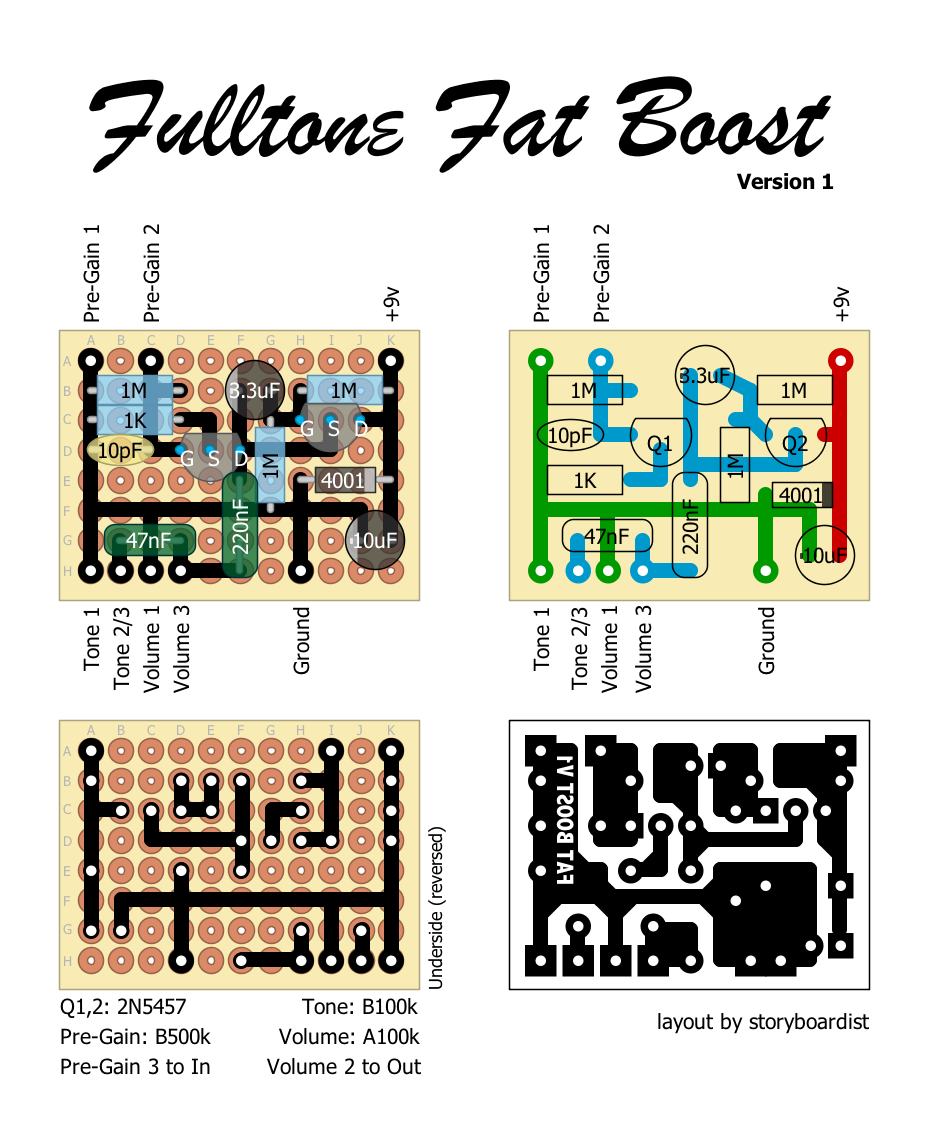
Fulltone Fat Boost v1

There was some controversy over this pedal from Fulltone as the circuit is practically identical to the Jack Orman Mini-Booster. Fulltone no longer makes this version of the Fat Boost and now makes a 4-control version with an extra FET stage and more EQ controls. Regardless, it's a great pedal for beefing up your tone. 


The perf and PCB layouts are slightly different. I was able to give the components more breathing room on the PCB that wouldn't be feasible on perf.