This is a library of perfboard and single-sided PCB effect layouts for guitar and bass. I'm not an electrical engineer by any stretch of the imagination, just a DIY'er who likes drawing layouts. It is meant for the hobbyist (so commercial use of any of these layout is not allowed without permission) and as a way to give back to the online DIY community.
Showing posts with label Electro Harmonix. Show all posts

Monday, September 12, 2022

EHX Small Clone

 The blog needs more modulation, so here's the classic EHX Small Clone chorus. Made famous by Kurt Cobain, the Small Clone has a wide range of chorus tones. I've laid it out two ways, one stock, and one with the Depth switch replaced with a pot. You can probably squeeze this into a 1590B, but I'd stick with a 125B if you want the board mounted to the pot(s). Schematic for reference.


Tuesday, April 9, 2019

EHX Bassballs

Not sure I missed doing this one ages ago, but better late than never. The Bassballs is a classic envelope filter that's been a staple of Electro Harmonix's line up for a long time. Designed for bass, but works great on guitar as well. Trimmers are very dynamic and might be fun as external pots. Also if it's super loud, adding a volume pot at the output is super easy—remove the 47k resistor off the Out pad, wire the Out pad to lug 3 of an A100k pot, lug 1 to ground, and lug 2 becomes the new circuit output. Here's the schematic for reference. Should fit in a 1590B, though it'll be a tight squeeze.


Tuesday, January 30, 2018

Electro Harmonix LPB-1

Got a request to redo the LPB-1 with the pot board mounted. Can't say I'm opposed and it only took about 5 min to layout. :) Easy fit in a 1590A. If you want to make the Screaming Bird treble booster, replace the two 100nF caps with 3.3nF.


Friday, June 30, 2017

Emanating Fist XB-70

The XB-70 is a clone of the Captain's personal '77(?) Guild Foxy Lady, which were built by Electro Harmonix and generally very similar to Ram's Head Big Muffs. In the Captain's own words, "It sounds like torn leather soaked in piss and salt smushed lovingly into ears... It is a brute of a pedal, has a really intense roar at full tilt, like any good Big Muff really." I used my old Ram's Head layout as the starting point, but altered the pot placement and it should be a nice fit in a 125B now.


Wednesday, February 22, 2017

EHX Hot Tubes

Here's the Hot Tubes overdrive from Electro Harmonix. It's based around a 4049 hex inverter chip (like a Red Llama) with a dual op amp pushing it. Original units from the 70s had buffered bypass and a direct out jack. I guess they needed something to fill up those massive enclosures EHX used back in the day. I've laid this out for a 125B enclosure with top mounted jacks and your favorite method of true bypass switching.


Monday, February 13, 2017

Electro Harmonix Soul Preacher

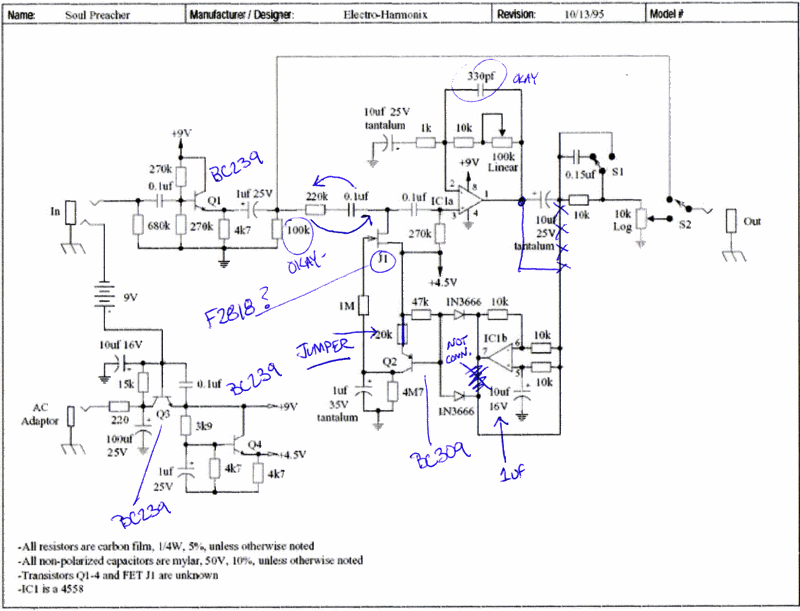
There have been a few different iterations of the Soul Preacher. This one follows the version that isn't based around an OTA chip (much like a DynaComp), but is rather much closer to an Orange Squeezer. The original used a buffered bypass, and I've included an extra pad for the buffer out if you want to build it that way. Here's the schematic for reference.

Monday, December 12, 2016

Electro-Harmonix OD Glove

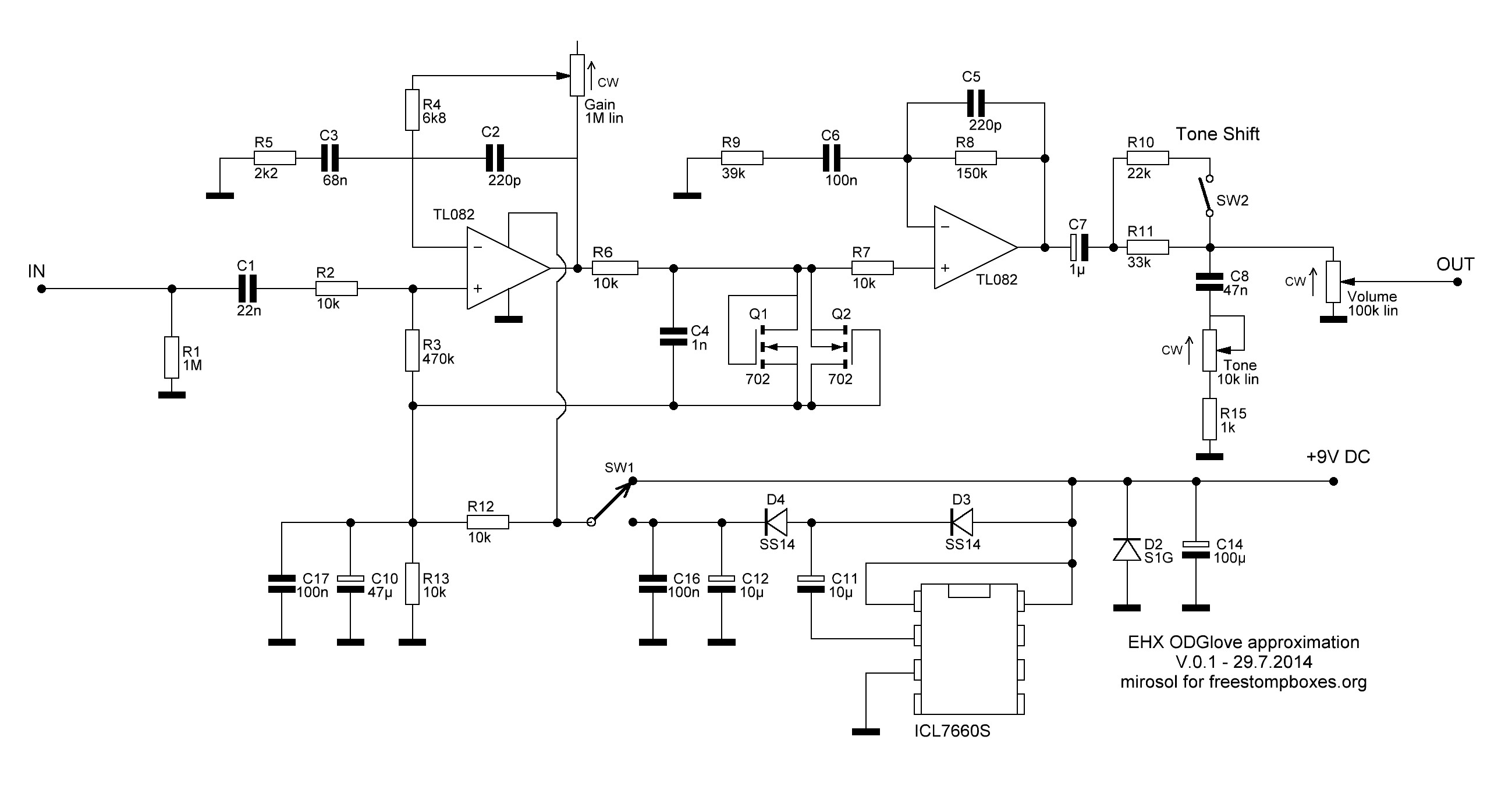
Here's the Glove from EHX's nano series. Essentially, it's an OCD with a switchable charge pump. On originals the voltage switch is internal, but external makes more sense to me, so wire that to your preference. Here's the schematic for reference.


Friday, July 22, 2016

EHX Satisfaction Fuzz

It's Fuzz Friday once again and this week we have the Satisfaction Fuzz from Electro Harmonix. It's essentially a Jordan Bosstone without the clipping diodes and a smaller output capacitor.


Friday, May 27, 2016

Electro Harmonix Big Muff - 1590a

Let's wrap up this 1590a week with one of the mightiest fuzzes of all time–the Big Muff. For this one, I've labeled all the components to correspond with the component names on Kit Rae schematics, so find an EHX version on there and populate the board accordingly. This probably won't work for some of the more modified, non-EHX Muffs, just fair warning. Polarity protection and power filtering have been added, as has a pull down resistor at in put. It's labeled as "PDR" on the layout and would typically be 1-2M. The resistor labeled "CLR" is the current limiting resistor for the LED, and can be anything from 2.2k to 10k.

Tuesday, September 29, 2015

Electro Harmonix Muff Fuzzes

Around the same time that the EHX Big Muff was first released in 1969, Mike Matthews also released the Muff Fuzz. It was unrelated to the BMP other than the name, and came in the same small enclosure as the LPB-1 that plugged straight into the guitar. Later it was re-released in a floor pedal as the Little Muff Pi and more recently as the Muff Overdrive. In the mid-70s, the circuit was updated, moving away from the Fuzz Face based transistor circuit to a design based around the popular JRC4558 op-amp. I've laid out both versions below and both should fit in a 1590a.


Monday, August 10, 2015

Electro-Harmonix Big Muff π

I got a request for a layout of the Big Muff that could be used to build the Triangle, Rams Head, Green Russian, or NYC versions. While it shouldn't be that hard to take one of my previous layouts of the BMP and make the value changes, I thought I'd make a more detailed project than I normally do. First, let's start with the schematic. This is the basic circuit used by pretty much every variation of the Big Muff (excluding the IC Big Muff):


The only difference between versions is a handful of component values. Generally, the circuit was tweaked to work with whatever Mike Matthews had on hand. As a result, there are about 18 different variations produced by Electro-Harmonix. Now, not all of those variations sound all that good. But over the years several really good sounding Muffs have been traced and their component values posted on the web (mostly on Kit Rae's awesome Big Muff site). The 4 versions specified in this project seem to be some of the most popular and best sounding Muffs.

The component names in the schematic above correlate to this layout:


For a full BOM for all 4 versions, download the file linked below. In addition to the BOM, it contains scaled transfers for etching your own circuit board, as well as a scaled drilling template for building the effect into a Hammond 1590B enclosure.


If a BMP variation you want to build isn't specified in this project, use the above schematic and compare it to the schematic of your desired version to figure out what components go where.

Updated Sept. 2, 2015 to correct schematic, placement of Tone pot, and drilling template.

Friday, July 10, 2015

Electro Harmonix Triangle Big Muff (again)

Haven't done a Big Muff layout in a while. This is the Triangle version again and is pretty much the same layout as before, but I changed the orientation of the Tone pot. I was going to build this myself and realized that I didn't like how far down the Tone pot was from the other 2 controls, so I tweaked it a little and I'm happier with it now.


Wednesday, July 8, 2015

Electro Harmonix Germanium OD

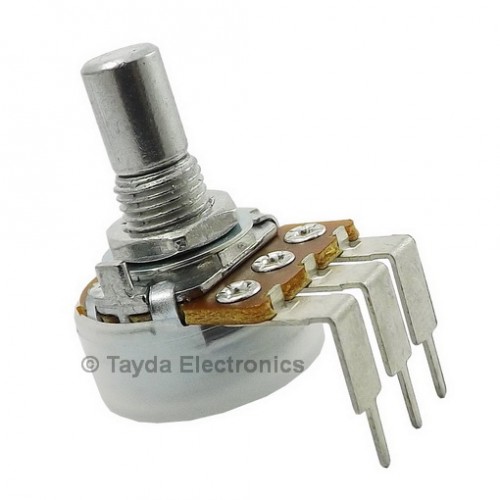
The EHX Germanium OD offers 60s overdrive tones using a combination of germanium and silicon transistors (all PNP). All 3 pots control the voltage is some way. The Bias pot controls the amount of voltage that reaches the Gain control, which in turn controls the remaining voltage that gets to the germanium transistor. The Volts control acts like a sag control on the overall voltage the circuit is running at, so you can emulate a dying battery. I've laid this out for on board pots mounted from the solder-side of the board using right angle PCB mount pots.


Tuesday, June 30, 2015

Electro Harmonix LPB-1 (and its siblings)

The LPB-1 was the first effect made by Mike Matthews and Electro Harmonix. Like many other effects at the time, it was housed in a small box that plugged directly into your guitar. It was designed to give you a volume boost and push the amp into overdriven territory. EHX still makes the LPB-1 (Linear Power Booster) to this day, as well as its sibling circuits, the Screaming Bird (also known as the Screaming Tree) treble booster and the Mole (also known as the Hog's Foot) bass booster. The LPB-1 and Screaming Bird/Tree can be built on the same board, as the only difference between the two is the input and output capacitor values (100n for LPB-1, 2.2n for Screaming Bird/Tree).


The Mole/Hog's Foot is basically the same circuit, again with differing input/output caps. However, there are 2 added 100n capacitors that make it necessary for a different board.


Thursday, May 14, 2015

Electro Harmonics Pulsar Tremolo

Here's the original EHX Pulsar trem from the 70s (not to be confused with the modern Stereo Pulsar EHX manufactures today). It features Intensity and Speed controls as well as a switch to go between a hard and soft wavefrom. Original units often suffer from clock bleed from the LFO section. So I've drawn a second layout with mods to try and fix it. The 470Ω resistor above the IC and the 47µ cap below Q1 should be tweaked to find the values that work the best. Pots can be board mounted from the solder-side using right angle PCB pots.


Wednesday, February 25, 2015

AMZ Dr. Quack

The Dr. Quack is Jack Orman's improvement on the EHX Dr. Q envelope filter. Basically, there's an added input buffer to increase the input impedance (which is kinda low in the Dr. Q) and offers better range control. Check out Jack's blog post on the circuit for more information and a few mods.


Tuesday, February 17, 2015

Electro Harmonix '77 OpAmp Big Muff

In the late 70s, Mike Matthews and EHX took the Big Muff on a detour from the traditional 4 transistor circuit in favor an IC-based circuit. It sounds very similar to the traditional Muffs, with the tone control being a little more flat than the traditional mid scoop. The circuit uses two favorite opamps from the 70s–the JRC4558 (used in the Ibanez Tube Screamer) and the LM741 (used in the Distortion +/OD250). The IC Big Muff would have probably faded into the background of Big Muff lore if it weren't for Smashing Pumpkins guitarist/frontman Billy Corgan. His use of a late 70s IC Muff on Siamese Dream has made the pedal highly sought after.

I've drawn the layout to use right angle pcb mount pots, mounted on the solder-side of the board. Also, if 741 chips aren't to your liking, you can use something like a TL071 in its place. Just increase the 820k resistor between the power and pin 3 to 1M.

Wednesday, February 4, 2015

EHX Big Muff - Triangle

I know, this is the 3rd different BMP layout I've done, but this is the one I'm the most happy with. It will easily fit in a 1590B, it has board mounted pots, and said pots aren't all in one row across the top. As with the other Big Muff layouts, you can build pretty much any version on this layout (just refer to the schematics), but the components listed here are for the '72 Triangle version. For the board-mounted pots, I drew this layout with these kind of pots in mind mounted on the solder-side of the board.


Thursday, January 8, 2015

EHX Big Muff - Green Russian

With the exception of the IC BMP ('77, '78) you can theoretically build just about any version of the Big Muff on any other version's layouts, but the values listed in this one are for the Tall Font Green Russian version. This one is smaller than the BMP layout I did with on board pots and you should be able to fit it in a 1590B if you shave down the sides of the board a little.

One of the better sounding versions of the Big Muff (IMHO anyway) and sounds great on both guitar and bass.


And if you want to cut through the mix a little better, here's the Green Russian with a modified tone stack, adding a mids control. Pinkjimiphoton over on FSB suggests using a higher value pot for the mids control (250k-1M) than the normal 100k that's listed. 


Update 3/16/15:
Modeffected pointed out that these 2 layouts were missing the 12k resistor from the power rail to the collector of Q3. Both layouts have been updated and should be correct now.

Monday, January 5, 2015

Jordan BossTone

This one was a request. It's another layout for Jordan BossTone, but with onboard pots. Because of the onboard pots I was able to add an anti-popping pull down resistor on the input. Q1 is NPN silicon (so 2N2222 or 2N3904) and Q2 is PNP silicon (2N2907 or 2N3906). The pot centers are 1.2 inches (≈ 3cm) apart. You can use this same layout for the EHX Satisfaction fuzz by leaving out the clipping diodes (1N4148s).