

Showing posts with label Hornby Skewes. Show all posts
Showing posts with label Hornby Skewes. Show all posts
Friday, September 20, 2019
Hornby Skewes Shatterbox
Got a request for this one for Fuzz Friday. Fairly simple fuzz + boost box. Originals used PNP silicon transistors, but you can use NPNs just as well. The perf side below reflects the original's positive ground and the etch side shows daisy-chain-able negative ground. If you want to put 2 footswitches in a 1590B you could, as the board is small enough for that. Schematic on FSB.


Friday, May 5, 2017
Hornby Skewes Zonk Machine II
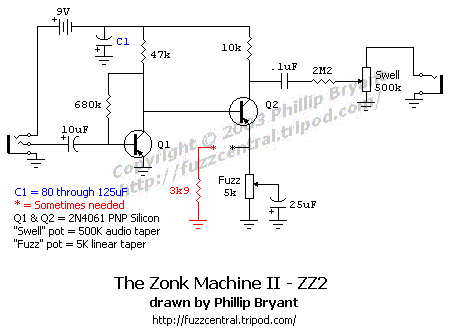
The Zonk Machine II was the more budget friendly version of the Zonk Machine. It was a simplified circuit and featured silicon transistors in place of germanium. Originals used 2N4061 PNP silicons, but other could be used. Because it's silicon based, it shouldn't be too hard to make the swap to NPNs so it can be daisy chained with other negative ground effects. I've laid out 2 versions of this, one for BCE pinout transistors (like the original 2N4061s) and one for CBE pinout transistors. The perf layouts reflects the original positive ground configuration, and the PCB layouts reflect negative ground configuration. Note that the 3.9k resistor isn't always necessary (it's there to make the Fuzz pot value 2k). Here's the schematic for reference.


Friday, April 28, 2017
Hornby Skewes Zonk Machine
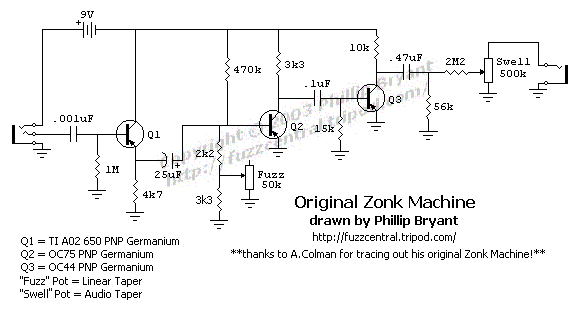
The Zonk Machine was one of the many British fuzz boxes that came out in the mid-60s. Like the Tone Bender Mk II it was designed to compete with, it also was featured 3 germanium transistors but offered more of a boost and slight oscillation (in a good way). This is a positive ground effect so unless you use a charge pump or can make it work with NPN germanium transistors you can't daisy chain it with other negative ground pedals. If you are going the NPN route, be sure to rotate the polarized caps an the diode 180º. Here's the schematic for reference.


Subscribe to:
Posts (Atom)