

Wednesday, August 31, 2016
Menatone Blue Collar
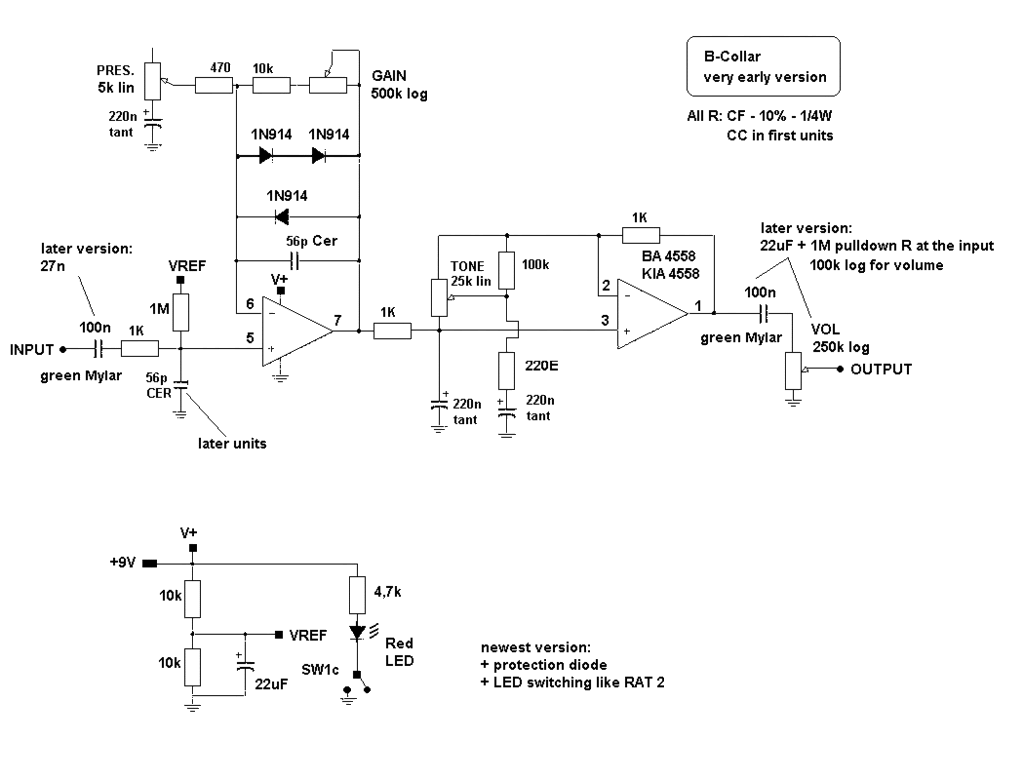
Here's an oldie but a goodie from Menatone. The Blue Collar was released around the same time as the Red Snapper and is more compressed and focused in comparison. It's also based around the Tube Screamer without the input buffers and with several mods. This layout reflects a newer version of the Blue Collar, but the older one can be built on the same board. Just increase the input cap to 100n, omit the 56p cap from pin 5 to ground, lower the output cap to 100n, and use an A250k pot for the Volume control. Here's the schematic for reference.


Monday, August 29, 2016
Valve Wizard Equinox II
Here's a reverb circuit that doesn't require a Belton brick–the Equinox II by Valve Wizard. It uses 2, PT2399 delay chips with a pretty standard input/output buffer built around a TL072. The original uses a J112 for switching the tails function, but I've simplified that with a just DPDT footswitch. Use one side of the DPDT for turning the reverb on/off, and the other side for LED indication. If you don't want/need tails with your reverb, just jumper the 2 switch pads. It's gonna be a snug fit in a 1590B, but it will fit.


I was able to verify this over the weekend and it works great and will fit nicely in a 1590B.


Friday, August 26, 2016
Catalinbread Merkin Fuzz
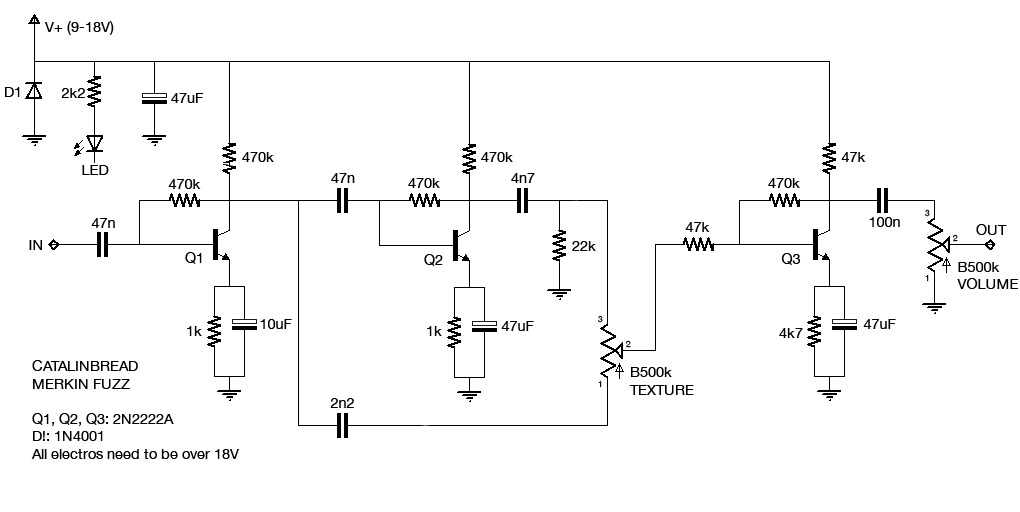
Here's an older one from Catalinbread, but a great sound fuzz for Fuzz Friday. It's based on the Mosrite FuzzRite but adds another gain stage after the Texture (Depth in the original FuzzRite) control. Schematic can be found here.


Wednesday, August 24, 2016
Menatone Red Snapper
Gotten a few requests for this one. It's a based on the Tube Screamer, but without the input and output buffers and a modified tone section. I've laid it out for board mounted pots and the electrolytic caps are folded on their sides.


Monday, August 22, 2016
Earthquaker Devices Grey Channel
This is the 400th layout on the blog. Kinda hard to believe I've drawn up that many. O_O
The cool dudes from Akron cooked up the Grey Channel, a dual overdrive based on the classic grey spec DOD 250. The 250/Distortion + circuit is one of my favorites and it turns out it's one of EQD's favorites as well:
It is based around a classic hard-clipping gray box overdrive (subtle hint, huh), one of my all-time favorites. Coincidentally, this is the very same pedal that got me started building pedals and launched EQD. It is two channels of a simple hard clipping overdrive that leaves the character of the guitar and amp intact. The Gray Channel retains the classic warm overdrive sound and expands upon it with several clipping options and bigger bass response. Each channel has 3 clipping modes. The Green channel- “Si” (Silicon clipping diodes), “Ge” (Germanium clipping diodes) and “N” (no clipping diodes). The “Si” mode will be bright/loud/fuzzy and has a natural tube type break up. “Ge” mode is a little looser with more lows and warmth and less output. “N” mode acts as a clean boost until you hit roughly 1 o’clock on the gain, at which point it’ll start to saturate the op amp into a biting, loud distortion. Phew! Still with me? Cool, onto the modes of the Red channel. Here, you’ve got “LED” (LED clipping diodes), “FET” (Mosfet clipping diodes) and “N” (again, no clipping diodes). “LED” mode is the loudest, cleanest and most touch sensitive/least compressed. “Mos” mode is the most compressed with a tighter crunch; the biggest hesher of the group. And finally, the “N” mode is the same clean to crazy loud op amp distortion set-up as the Green channel. With a couple of switch clicks you can go from your bypassed tone to warm break up to over-the-top gnarly grind and any/every combination in between.
Using the above info from the EQD product description, I've come up with a work-a-like to the Grey Channel. Using the Grey Spec 250 schematic as a base, I drew up 2 of them using a single 1458 IC (a dual version of the 741), increasing the value of the input capacitor to 22n (feel free to adjust that to taste) for extra bass response and including the various clipping options outlined above. I also changed the value of the gain pots from C500k to B1M, which is a fairly common mod to 250/Disto + circuit.


The cool dudes from Akron cooked up the Grey Channel, a dual overdrive based on the classic grey spec DOD 250. The 250/Distortion + circuit is one of my favorites and it turns out it's one of EQD's favorites as well:
It is based around a classic hard-clipping gray box overdrive (subtle hint, huh), one of my all-time favorites. Coincidentally, this is the very same pedal that got me started building pedals and launched EQD. It is two channels of a simple hard clipping overdrive that leaves the character of the guitar and amp intact. The Gray Channel retains the classic warm overdrive sound and expands upon it with several clipping options and bigger bass response. Each channel has 3 clipping modes. The Green channel- “Si” (Silicon clipping diodes), “Ge” (Germanium clipping diodes) and “N” (no clipping diodes). The “Si” mode will be bright/loud/fuzzy and has a natural tube type break up. “Ge” mode is a little looser with more lows and warmth and less output. “N” mode acts as a clean boost until you hit roughly 1 o’clock on the gain, at which point it’ll start to saturate the op amp into a biting, loud distortion. Phew! Still with me? Cool, onto the modes of the Red channel. Here, you’ve got “LED” (LED clipping diodes), “FET” (Mosfet clipping diodes) and “N” (again, no clipping diodes). “LED” mode is the loudest, cleanest and most touch sensitive/least compressed. “Mos” mode is the most compressed with a tighter crunch; the biggest hesher of the group. And finally, the “N” mode is the same clean to crazy loud op amp distortion set-up as the Green channel. With a couple of switch clicks you can go from your bypassed tone to warm break up to over-the-top gnarly grind and any/every combination in between.
Using the above info from the EQD product description, I've come up with a work-a-like to the Grey Channel. Using the Grey Spec 250 schematic as a base, I drew up 2 of them using a single 1458 IC (a dual version of the 741), increasing the value of the input capacitor to 22n (feel free to adjust that to taste) for extra bass response and including the various clipping options outlined above. I also changed the value of the gain pots from C500k to B1M, which is a fairly common mod to 250/Disto + circuit.


You can wire two separate on/off footswitches if you want, but if you want to wire it like the original with a master on/off and then channel selection, wire it like this:

Connect X to X and Y to Y. If you want to use a bi-color LED in place of D2-3 you'll need to wire it like this.

Friday, August 19, 2016
Wampler Velvet Fuzz
The Velvet Fuzz is a unique fuzz that combines amp emulation and 2 different selectable fuzz tones. The toggle selects between a LM386 (Tight) circuit, and a 2N5089 (Big) circuit. These then push a Plexi Drive circuit that gives the Marshall amp emulation. The modular nature of this design gives you the option to have not only a Velvet Fuzz, but a Plexi Drive in the same box. The board is laid out for board mounted pots and I've included trimmers to help bias the J201 JFETs. I've also included a switch diagram to show how to wire the toggle switches.


Wednesday, August 17, 2016
Wampler Cranked AC
Another amp emulation overdrive from Wampler that's supposed to sound like (you guessed it) a cranked Vox. This one has been discontinued, but was very popular. It's very similar to the Plexi-Drive, but doubles the transistors and there are a few component changes. I've added trimmers to help bias the J201s.


Subscribe to:
Posts (Atom)