This is a library of perfboard and single-sided PCB effect layouts for guitar and bass. I'm not an electrical engineer by any stretch of the imagination, just a DIY'er who likes drawing layouts. It is meant for the hobbyist (so commercial use of any of these layout is not allowed without permission) and as a way to give back to the online DIY community.
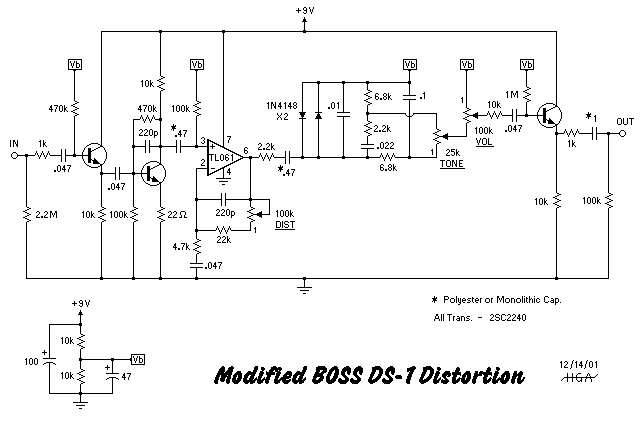
Here's the classic Boss DS-1 Distortion, used by many greats like Kurt Cobain, Joe Satriani, and Steve Vai, just to name a few. This one has been modified to eliminate the typical Boss flip-flop switching so it can be wired for true bypass, but it retains the input and output buffers.
For this week's #fuzzfriday, I present the Frantone Peach Fuzz. Got a request for this one. Quiet circuitry and classic fuzz and overdrive tones. It seems to be the circuit the Danelectro Cool Cat fuzz was based on, and that thing sounds great (it was one of my first pedals when I started playing). Original units use relay switching and the circuitry for that has been omitted from the layout below.
Got a lot of requests for this one. The Tight Metal is an over the top crunch machine for metal players. It has 2 effects loops, which not everyone will want. So just jumper those pads if you don't want that feature. The Gate pot is an internal trimmer, but I thought it might be useful off the board. This effect can be run off either +9v or +18v, and you should be able to fit this in a 125B.
The MagnaVibe is a vibrato effect inspired by the built in effect on old Magnatone amplifiers. From the BigFoot Fx description:
The Magnavibe was inspired by the early 1960's vibrato guitar effect (not the typical tremolo which is just pulse modulation). The Magnatone amp was known for having that amazing wobbly sound. Setting out to put that type of sound in a box and use it with any amp took much experimenting. The results are excellent. This is not a plain one dimensional vibrato such as a chorus pedal with the dry mix removed. Delay chips weren't even used back then. Nor is it just another uni-vibe clone, but a unique sound with that classic unique tone. Adding spring reverb or delay after the vibrato sounds especially good. I've drawn it so there's space to use a VTL5 or similar photocell, or you can make your own. Either way, theres space for it. A lot of layouts I've seen don't allow for a comfortable enough space to get the LDR and LED lined up nicely. You might even be able to get this to fit in a 1590a.
Here's an op-amp based boost circuit from Jack Deville (Mr. Black Effects). He was kind enough to share his schematic a couple years ago on FSB. I stumbled upon it and thought it would be a good addition here. It should easily fit in a 1590a, and you can probably board mount the pot too.
The Bit Commander is an synth/octave effect that's all analog. It creates square wave synth tones across 4 octaves (2 up, 2 down) and it's capable of creating a wide range of sounds. The octave down effect is generated from the ICs, while the octave up comes from the 4024 and transformer (kind of like an Octavia). From EQD:
Like all analog octave effects, there are some basic rules to follow that will get you the most enjoyment from your Bit Commander. Use the neck pickup and play single notes. The best tracking occurs from the 7th fret up on all the strings. Below the 7th will still track but there will be occasional glitches and stutters. The lower the note, the harder it is for the Bit Commander to register. The use of Bass and lower registers on keyboards will yield unexpected, sometimes pleasing, sometimes disgusting results. These are not mistakes or flaws, it is the nature of analog octaves.
Happy #fuzzfriday, everybody! The 69 is Fulltone's take on the classic, late 60s, germanium Fuzz Face circuit. They've added a few extra controls to help shape the fuzz. The Bias (or Input as it's called in the 69 Mk II) pot is a common mod to the Fuzz Face circuit (it's a trimmer in the AnalogMan Sunface) and controls the input impedance. It can clean up the sound a little, just like rolling down the volume pot on the guitar. The Contour pot controls some of the voltage going to Q2 and the output cap. For more info, here's the schematic. Pots can be board mount from the solder-side of the circuit board and it should all fit in a 1590B just fine. The perf side of the drawing shows positive ground and the PCB side shows negative ground. Typical Fuzz Face germanium transistors should be used (Q1: hFE ~70, Q2: hFE ~100), but as always, socket and experiment.